

















It’s no longer a novelty when someone asks Alexa for tonight’s dinner recipe or Google Assistant to find the nearest physiotherapist. It’s routine. What began as a convenience is now reshaping the way consumers discover, decide, and act.
And here’s the part most marketers underestimate: voice isn’t just a new search format—it’s a behavioral shift. A fundamental change in how your customers interact with devices, seek information, and expect answers.
When your audience skips the screen and speaks directly to search engines, they expect immediate, conversational, and accurate results. If your business isn’t prepared for that moment, you’ve already lost them to someone who is.
That’s where Voice Search Optimization becomes your edge.
Rather than chasing algorithm updates or pouring money into trend-based tactics, savvy marketers are looking ahead. They’re studying emerging voice search trends not just to adapt, but to lead. Because the future belongs to brands that don’t just react—they future-proof.
In this guide, we’re not just showing you how to keep up. We’re handing you the playbook to stay ahead.
If your goal is to build a future-proof marketing strategy that evolves with how people search, not just where they’re typing less and talking more, then you’re right where you need to be.
What Is Voice Search Optimization (VSO)?
When people speak to their devices, they aren’t just searching—they’re expecting answers that sound human, feel instant, and solve a need without scrolling. That shift opens a new playing field, and Voice Search Optimization (VSO) is your blueprint to win it.
This section breaks down how VSO redefines the rules of traditional SEO, why it’s no longer optional, and what actionable insight you’ll walk away with to shape a more innovative, more relevant strategy. Whether you’re a marketer, SEO strategist, or a business owner trying to stay ahead, understanding VSO isn’t a trend-following move—it’s a future-proofing decision.
Definition and How It Differs from Traditional SEO
Voice Search Optimization is the process of tailoring your content, website structure, and metadata so your business appears in voice search results—the ones read aloud by Siri, Alexa, or Google Assistant.
But here’s the key difference: traditional SEO caters to how people type; VSO caters to how they talk.
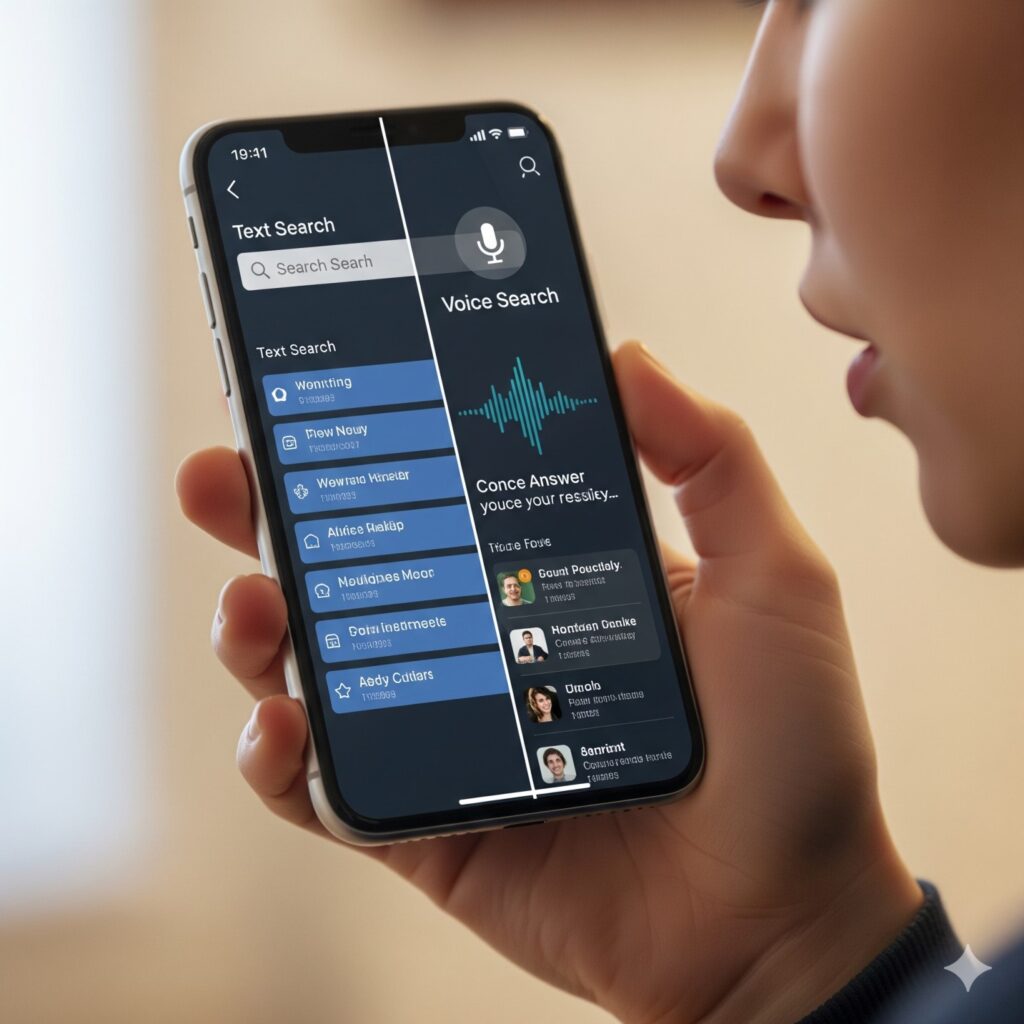
With VSO, you’re not just climbing a SERP. You’re aiming to be the one answer spoken aloud, not just one of ten blue links. That means optimizing for natural language, long-tail keywords, featured snippets, and structured data like FAQ schema—all working together to meet user intent faster and more conversationally.
And while traditional SEO might still get you clicks, VSO gets you something more valuable: instant trust in the moments that matter most.
Examples of voice queries vs text queries
People don’t speak like they type, and Google knows it. Take a look at how the same intent takes two very different shapes:
| Search Intent | Typed Query | Voice Query |
| Find nearby services | “Physio clinic NYC” | “Where can I find a physiotherapy clinic near me?” |
| Product search | “Best Smart TVs 2025” | “What are the best smart TVs to buy in 2025?” |
| Instructional | “pasta recipe quick” | “How do I make a quick pasta recipe with tomatoes?” |
| Local intent | “Pizza delivery is open now.” | “Who delivers pizza near me right now?” |
| Navigation | “directions JFK to Manhattan” | “How do I get from JFK Airport to Manhattan?” |
Voice queries are longer, more conversational, and often framed as questions. That means your content strategy must adapt, not just with keywords, but with the way you structure information.
Businesses that understand this behavioral nuance are the ones already showing up in Google’s featured answers, earning that spoken spot that builds credibility and conversions.
How Voice Search Is Reshaping Digital Marketing
When your audience speaks, they skip the fluff and get straight to what they need. That’s not just a shift in technology, it’s a shift in expectation. And if your digital marketing strategy still leans on static web pages and keyword-stuffed headlines, you’re competing in a game that’s already evolved.
Voice search trends are rewriting how people discover brands, consume content, and make decisions. This isn’t about futurecasting, it’s about recognizing how real behavior has changed and adjusting your strategy accordingly.
This section uncovers the most pivotal transformation markers: intent, delivery, and SERP dynamics, so your strategy aligns not just with the algorithm, but with how people live and search today.
Impact on Search Intent, User Expectations, and Content Delivery
When someone pulls out their phone and speaks a question aloud, what they’re saying is, “Give me the fastest, most accurate, and most relevant answer—now.”
Search intent used to be a puzzle we decoded through keyword combinations. With voice search optimization, it’s become more precise but more demanding. Queries are no longer vague; they’re personal, question-based, and driven by real-life needs in real time.
People ask:
- “What’s the best CRM for a small business?”
- “How much protein does an avocado have?”
- “Is there a walk-in clinic open near me right now?”
To match that shift, your content must deliver clarity, not clutter. That means concise answers, contextually rich copy, and mobile-first formatting that search engines can easily parse and voice assistants can confidently read aloud.
If your brand doesn’t meet this expectation, you’re not just missing traffic—you’re losing relevance.
Voice-Driven Changes in SERP Features
Voice assistants don’t list 10 blue links. They give one answer. And nine out of ten times, that answer is pulled from a featured snippet or zero-click result.
If you’re not optimizing for that spot, you’re invisible.
The rise of zero-click searches means more users are getting what they need without ever clicking through. That changes how we measure success; it’s no longer about just ranking, it’s about being the answer.
To secure that position, your content needs:
- Clear FAQ sections targeting question-based keywords.
- Structured data like schema markup.
- Paragraphs that answer queries within the first 40–50 words.
- Clean formatting that allows Google to extract information easily.
Top Voice Search Ranking Factors You Need to Know
Voice assistants don’t guess—they deliver the most trusted, optimized response within seconds. If your website isn’t designed to meet those standards, you’re not just missing rankings, you’re missing relevance. This section breaks down the key ranking factors that decide whether your brand gets spoken… or skipped.
Page Speed, Mobile-Friendliness, Conversational Keywords, and Schema
Voice search optimization starts where most users are: on their phones, asking for quick answers. If your page takes more than a few seconds to load, the opportunity is already gone.
Google prioritizes fast-loading pages, especially those optimized for mobile-first indexing. But speed alone won’t win you the voice spot—you need to combine mobile-friendliness with conversational keywords and structured clarity.
That means:
- Replacing robotic keyword stuffing with natural, question-based phrasing like “how do I,” “what’s the best,” or “where can I find…”.
- Writing in a tone that matches how people speak, not how they search in text.
Using FAQ schema markup to help search engines find your best answers fast. - Structuring content so that voice assistants like Siri or Google Assistant can easily parse it.
And here’s where most sites fall short: they have the answers, but not in a format that search engines can trust and read aloud. Schema isn’t optional—it’s your entry ticket into the featured snippet game. If you’re building a future-proof marketing strategy, these aren’t technical extras—they’re foundational.
The Role of Local SEO and Google Business Profile
Ask anyone with a smart speaker or phone how often they use it to find something “near me.” The answer? Often.
That’s why local SEO is a major driver of voice search results. Whether it’s “best dentist near me” or “restaurants open now,” these queries trigger map-based, hyper-local results—and your presence depends on how well you’ve optimized your Google Business Profile (GBP).
Here’s what matters:
- Your GBP must be complete, accurate, and consistent across all listings.
- Categories, services, hours, photos, and reviews should be updated regularly.
- Voice searches prioritize businesses with high ratings, fast load times, and relevance to the spoken intent.
For local brands, Google Business Profile optimization is one of the most overlooked but high-impact ways to get discovered through voice assistants. It feeds the very database that powers local voice responses.
If you’re serious about ranking for “near me” searches, it’s not just about SEO anymore—it’s about visibility where people speak, not just where they type.
Voice Search Optimization Strategies for Your Website
More people are speaking to their devices than ever before—and those devices are listening closely. Whether it’s “What’s the best eco-friendly air purifier under $200?” or “Where’s the closest EV charging station?”, voice assistants are rewriting how we find and engage with content. For brands and websites, this shift isn’t a prediction—it’s already affecting visibility, rankings, and conversions. This section will show you exactly how to align your website with voice search optimization strategies that work in 2025 and beyond. If you want to appear in those coveted voice snippets and position your brand for hands-free discovery, here’s how to speak the search engine’s language—literally.
How to optimize content for conversational and question-based queries
People don’t talk like robots, and voice search finally reflects that. Instead of keywords like “best running shoes,” users now ask, “What are the best running shoes for flat feet?” This means your content must adapt to natural language processing by mirroring how people speak.
Begin by incorporating long-tail keywords and question-based queries that your audience is likely to ask. Use tools like AnswerThePublic or Google’s “People also ask” to uncover real phrasing. Then structure your headings, intros, and even sub-bullets to echo these conversational search patterns. It’s not just good for voice, it’s suitable for engagement.
If you’ve ever asked, “How do I get my site featured in voice search results?”—the answer is this: match your content to the questions your customers are already asking. Let your content be their answer.
Implementing FAQ schema and structured data
Search engines don’t just need content—they need context. And structured data gives it to them. By adding FAQ schema markup, you tell Google exactly what each question-answer pair on your site means so that it can be featured directly in voice search snippets and zero-click results.
Whether you’re using WordPress, Shopify, or any major CMS, implementing schema.org markup (or using tools like Rank Math or Yoast SEO) lets your FAQs become indexable, machine-readable gold. Think of it as speaking directly to the algorithm, saying: “Here’s the precise answer to the user’s question.”
This one update can drastically boost your voice search visibility and place your brand above traditional results. Not because you’re shouting louder, but because you’re structured smarter.
Creating voice-friendly landing pages
Most landing pages are designed to convert visitors into leads. But with voice search, there’s often no click at all—just an answer. That’s why building voice-friendly landing pages is a decisive move. Start by designing pages around explicit, specific intents—with headlines that reflect real queries like “How do I apply for a solar tax rebate?” and concise answers immediately below them.
Use bullet points, short paragraphs, and a mobile-first structure to make the content scannable by both humans and machines. Incorporate location-based keywords, action verbs, and “how-to” formatting. The goal is to make it easy for voice assistants to pull answers from your page, and even easier for users to trust what they hear.
When your site becomes the voice in someone’s ear, you’re not just optimizing—you’re owning the conversation.
Local SEO and Voice Search: Winning the ‘Near Me’ Battle
When someone pulls out their phone and says, “coffee shop near me” or “best dentist open now,” they’re not browsing—they’re ready to act. And voice search has made local SEO more urgent and competitive than ever. For local businesses, showing up in that split-second result could be the difference between a customer walking in or walking right past. This section is your roadmap to ranking for voice search in your area, by aligning your digital presence with what real people are saying—and what voice assistants are prioritizing.
How Local Businesses Can Rank for Voice-Driven Queries
Voice queries are action-driven and location-heavy. People are searching with urgency—“Where can I get an oil change near me?” or “What’s the top-rated Thai restaurant around here?” To show up in those moments, your business needs more than just a website—it needs local signals that search engines trust.
That means optimizing your site and content for location-based keywords, embedding natural phrases like “affordable vet in Austin” or “emergency electrician open late in Chicago.” Use conversational copy, not robotic strings, and make sure each service page reflects the geographic area you serve.
But content alone won’t carry you. Google’s local pack is influenced by reviews, proximity, relevance, and consistency—so if your business info isn’t aligned across platforms, you’re unlikely to be that top voice result. It’s not about outspending big brands—it’s about being locally specific, hyper-relevant, and instantly trustworthy.
Tips to Optimize Listings and Location-Based Intent
- Claim and fully complete your Google Business Profile.
- Add high-resolution photos.
- Keep your business hours up to date.
- Include mobile-friendly contact information.
- Write a compelling business description with primary keywords and service areas.
- Encourage customers to leave detailed reviews using terms like “best,” “top-rated,” or “closest.”
- Respond authentically to reviews to build trust.
- Ensure NAP (Name, Address, Phone Number) consistency across local directories, social media, and your website.
- Use location-based schema markup to make your business data machine-readable.
- Utilize tools like Rank Math or Schema Pro for structured data implementation.
- Localized landing pages for each key city, neighborhood, or region you serve.
- Write content using natural, voice-friendly language that reflects how users speak.
Content Creation for Voice: Think Like Your User Speaks
The brands dominating voice search results aren’t the ones with the longest blogs or the flashiest visuals. They’re the ones whose content sounds like what users are already asking.
Voice assistants don’t guess; they respond. And they respond best to content that mirrors the way people naturally speak. This section shows you how to stop writing for search engines and start writing for humans, the kind who ask real questions and expect clear answers.
How to Write Like People Talk Instead of How They Type
People don’t say, “Dentist NYC hours.”
They ask, “What time does the dentist near me close tonight?”
That difference is where voice search optimization begins. Your content needs to reflect conversational search intent, not robotic keyword patterns. And that means rethinking how you approach headlines, body copy, and CTAs.
Start by:
- Framing sentences as answers to real questions
- Keeping tone warm, helpful, and to the point
- Avoiding jargon, buzzwords, or complicated phrasing
- Using contractions (you’ll, we’re, it’s) to sound human, not like a legal document
Google favors content that sounds right when read aloud. So read your copy out loud. If it sounds stiff, fix it. Voice search content must feel like a conversation, not a broadcast. The result? Higher retention, increased engagement, and a better shot at landing that all-important featured snippet.
Using Long-Tail and Natural Language Phrases
Short-tail keywords may still serve PPC campaigns, but they fall short in voice-driven discovery. That’s because people don’t say “shoes”; they say, “What are the most comfortable running shoes for flat feet?”
These are long-tail keywords—and they’re the backbone of effective voice content.
Why?
Because voice queries are:
- Specific (“best email tool for freelancers”)
- Intent-rich (“how do I schedule emails in Gmail?”)
- Natural (“What’s the easiest way to learn coding at home?”)
To align with this, map your content strategy around:
- Frequently Asked Questions that your audience asks
- Topic clusters built around searcher problems and real-world phrasing
- Tools like Google’s “People Also Ask,” AnswerThePublic, and your live chat history
When you write for how people talk, you stop chasing algorithms and start aligning with intent. That’s what earns voice visibility, brand trust, and conversions—without needing to shout for attention.
Common Mistakes to Avoid in Voice SEO
You can have the fastest site, great content, and even a mobile-first layout—yet still miss the mark on voice search optimization. Not because you aren’t trying, but because you’re optimizing for the screen while your users are talking to speakers.
This isn’t a space for trial and error. Voice search is direct, intent-driven, and brutally efficient. To win, your brand has to be the same. Here’s what’s holding most marketers back—and what’s quietly keeping your site out of that coveted spoken result.
❌ Ignoring Mobile Experience as a Core Signal
If your site’s mobile version is clunky, slow, or hard to navigate, voice assistants will skip it, no matter how good your content is. Mobile-first indexing isn’t a checkbox; it’s the foundation of modern voice SEO. Fast load times, intuitive navigation, and clear CTAs aren’t optional—they’re ranking signals.
❌ Writing for Keywords, Not Conversations
Still stuffing exact-match terms like “best chiropractor NYC”? That may have worked in 2013. But voice queries sound like real people asking real things. If your content doesn’t mirror natural language, Google won’t choose it as the answer. Use conversational phrasing, not search-console speak.
❌ Overlooking Schema Markup
You could have the perfect answer, but if it’s buried in a wall of text without proper FAQ schema or structured data, Google’s not surfacing it. Schema helps search engines understand where the answer is. Without it, you’re invisible to voice assistants scanning for fast responses.
❌ Treating Local SEO as Secondary
Most voice searches are local by nature, think “coffee shop near me” or “open dentist now.” Yet many businesses forget to fully optimize their Google Business Profile or keep NAP (Name, Address, Phone) data consistent. That one oversight? It’s costing you traffic and footfall.
❌ Using Long Paragraphs Instead of Scannable Answers
Voice results prefer content that’s easy to parse. If your copy reads like a novel, it’s not getting read aloud. Focus on concise, direct answers in under 50 words, especially for question-based queries.
Tools and Metrics to Track Voice Search Performance
If you’re not measuring it, you’re not improving it. And when it comes to voice search optimization, relying on surface-level SEO tools won’t reveal what gets your content read aloud. Your goal isn’t just to rank—it’s to be the spoken answer. That requires specific tools, smarter metrics, and a consistent pulse on how your voice content is performing across intelligent assistants, mobile search, and local results.
Let’s walk through the tools and tactics that bring absolute clarity to your VSO strategy—so you’re not just publishing content, you’re perfecting it.
Voice Search Analytics and Keyword Research Tools
Most businesses obsess over the wrong metrics: page views, bounce rates, and generic keyword rankings. None of that tells you whether you’re winning in voice search.
What you need instead:
- Answer The Public – A goldmine for discovering natural language queries people are asking across search engines. Perfect for structuring FAQ content that targets voice queries.
- AlsoAsked.com – Dig deeper into “People Also Ask” chains to capture contextual follow-up questions that voice assistants often rely on.
- SEMrush & Ahrefs – While not voice-specific, both help uncover long-tail keyword trends and SERP feature tracking (e.g., featured snippets), which heavily influence voice rankings.
- Google Search Console – Pay close attention to question-based queries, average position in mobile results, and high-impression/low-click terms—these are indicators that your answer might be shown in zero-click voice results.
- Local Falcon or Whitespark – For local businesses, these tools help you visualize Google Business Profile performance, visibility in “near me” queries, and proximity-based voice-triggered results.
Being intentional with voice-focused SEO tools isn’t just about tracking keywords; it’s about understanding spoken intent and aligning content to match that expectation.
How to Test and Refine Your VSO Strategy
Publishing once and walking away isn’t a strategy, it’s a guess. Winning in voice search requires iteration, which involves testing how well your content responds to how people ask.
Here’s how to stay in control:
- Use Google Assistant or Siri yourself to test your top queries. Are you showing up? Is your answer being read aloud?
- Conduct voice search simulations across different devices, locations, and times of day. Voice results are highly contextual.
- A/B test headline structures, schema usage, and content length. See which answers get picked up more frequently.
- Track whether content updates impact your presence in featured snippets, local packs, or voice readouts.
Refinement comes from paying attention. What gets rewarded in voice search performance isn’t just good content; it’s the correct format, phrased for humans, structured for machines.
Future-Proofing Your Marketing Strategy: What’s Next?
Voice is not the destination; it’s the foundation. The future belongs to brands that embed voice into the core of their digital experience, not just treat it as another channel.
- Adopt a conversational-first mindset
Build digital experiences that mirror fundamental interactions—voice search, chatbots, and natural language interfaces should drive how users engage with your brand. - Focus on intent, not just keywords
Voice queries are contextual and predictive. To win, optimize content that answers why users ask, not just what they ask. - Invest in multimodal readiness
The next evolution of search blends voice, visual, and AI-generated content. Prepare by making your content accessible, structured, and adaptable across platforms. - Streamline for clarity and speed
Google favors answers that are quick, concise, and accurate. Your content should reflect authority, be easy to read aloud, and load fast on any device. - Leverage real-time behavioral data
Monitor voice search trends, mobile engagement, and local query intent to keep evolving your content strategy in line with shifting user behavior. - Stay schema-smart
Structured data like FAQ schema, HowTo, and LocalBusiness markup continues to power featured snippets—and ultimately, voice responses. - Treat voice as a revenue driver
Voice is not just for search visibility—it influences purchases, bookings, and foot traffic. Your content should not only rank—it should convert.
Conclusion
Voice search isn’t a prediction—it’s already here, quietly reshaping how your audience finds answers, makes decisions, and chooses brands to trust.
Whether they’re searching for the nearest dentist, asking about product reviews, or seeking a quick “how-to,” users expect conversational, real-time, and accurate responses. And search engines are listening.
By implementing the right voice search optimization strategies, structuring your content to match how people speak, and staying ahead of emerging trends like schema, local SEO, and multimodal search, you’re not just playing catch-up—you’re leading.
This isn’t about keywords anymore. It’s about connection. And the brands that win are the ones that don’t just get found—they get spoken aloud.