

















As life gets busier, the need for convenience has become a top priority. Whether it’s checking the weather, setting reminders, or searching for the best deals, voice search has become the go-to method for many. It’s quick, hands-free, and effortless. Tools like Siri and Alexa are so seamlessly integrated into daily life that we often forget they are powered by AI, a technology that’s changing the way brands connect with their customers. Voice search is no longer just a novelty. Approximately 90% of people find voice search easier than typing a search online, underscoring the significant growth of voice search and its increasing importance in the customer journey.
In this blog, we’ll dive into how AI in marketing and voice search are transforming digital marketing strategies. Keep reading to find out how integrating AI and voice search can enhance your brand’s presence and reach.
The Rise of AI Voice Search in Customer Interaction
Consumer behavior is evolving at an unprecedented rate. What was once a short, keyword-based query is now evolving into full-length, conversational questions. Instead of typing “coffee near me,” users are now speaking more naturally, asking, “What’s the closest coffee shop to me?”
Here’s a closer look at how consumer search behavior is evolving:
- Full-Sentence Queries: Consumers now prefer asking voice assistants more specific, full-length questions, rather than typing short keywords.
- Question-Based Searches: With voice search growing, users now ask clear, direct questions, such as “Where can I find the best coffee near me?” instead of simply typing “coffee shop.”
- Increased Conversational Tone: The way people phrase searches has become more natural, mirroring how they would talk to a person rather than a machine.
With this transition, search engines have had to adapt. Google, for example, has refined its SEO strategies to prioritize long-tail keywords and question-based searches, catering to full-sentence queries. Search engines are becoming more intelligent and better able to process context, intent, and nuances in human speech.
Brands must rethink how they structure and optimize their content to engage with users in this new way. Brands are increasingly focusing on:
- Optimizing Content for Voice Search: To capture the attention of voice search users, businesses are focusing on creating content that answers specific questions and uses conversational language. Long-tail keywords and structured answers are becoming critical.
- Incorporating Voice Search into Marketing Campaigns: As more people utilize voice assistants for search, businesses are incorporating voice search features into their websites, apps, and digital marketing efforts to make their content more accessible and user-friendly.
As voice search continues to grow, AI plays a vital role in enhancing search accuracy and relevance. However, we’ll dive deeper into how AI specifically powers voice search accuracy and relevance in the next section.
How AI in Marketing is Shaping Voice Search Experiences
AI has revolutionized marketing by enabling a level of personalization that was once unimaginable. Businesses can tailor their messages and offers to individual customers based on a wealth of data, preferences, behavior, past interactions, and even real-time actions. This personalization makes the entire customer journey smoother, more intuitive, and aligned with the unique needs of each consumer.
Voice search, as part of this shift, has become a major player in delivering this personalized experience. The integration of AI into voice search enables businesses to connect with consumers in a more human-centered manner. Here’s how this process works from start to finish:
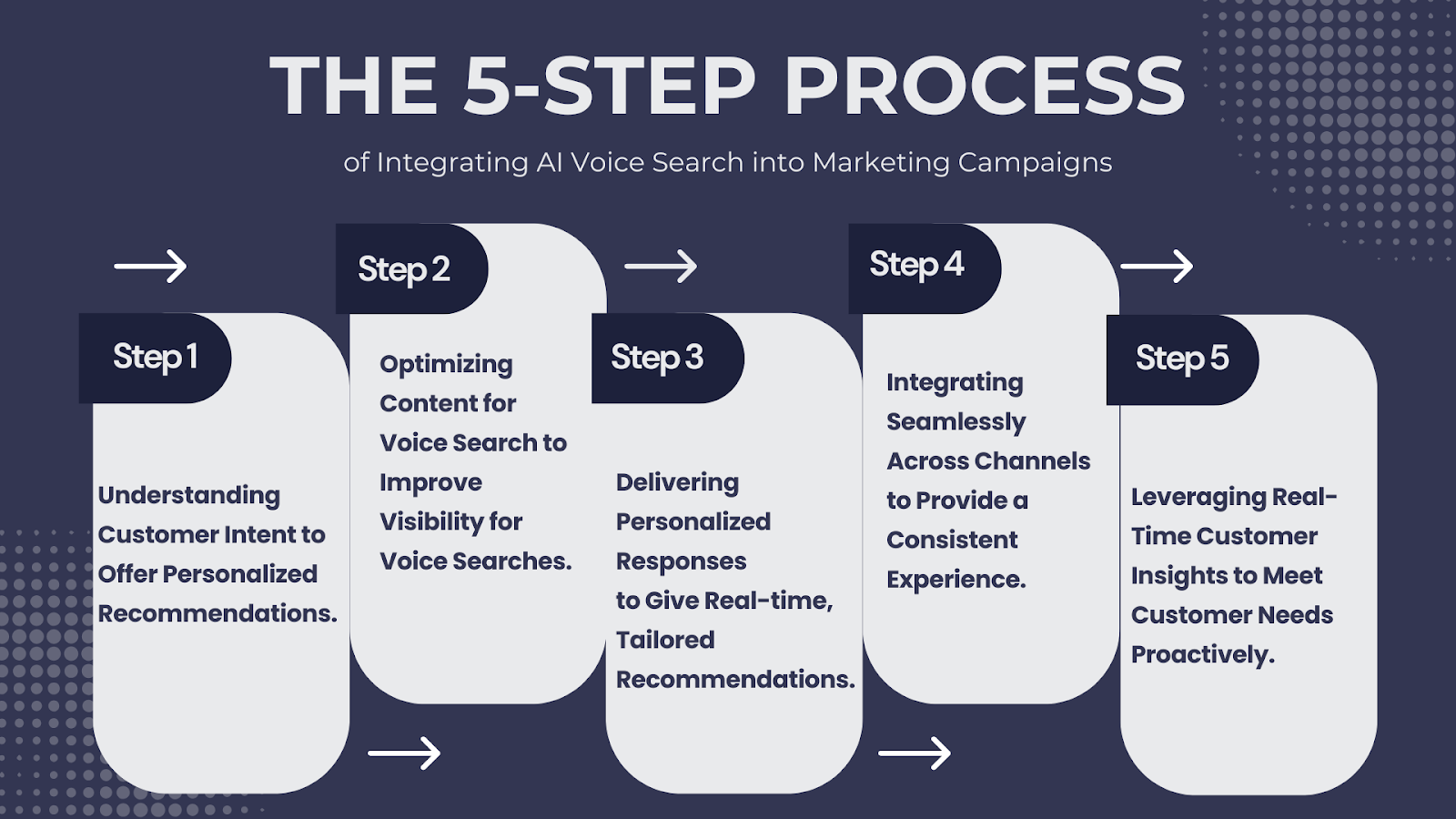
AI also helps brands gather real-time customer insights. As consumers interact with voice search technologies, they unknowingly provide valuable data that can be analyzed and used to improve marketing strategies.
- Understanding User Behavior: Each voice query offers a glimpse into what a consumer is looking for in the moment. By analyzing these voice queries, brands can gain real-time insights into customer preferences, needs, and pain points.
- Predicting Future Needs: Over time, AI learns from interactions and begins to predict future behavior. By identifying patterns, businesses can anticipate customers’ next moves and proactively offer relevant content, promotions, or product suggestions.
- Enhancing Customer Engagement: By leveraging AI to analyze voice search data, brands can create more engaging experiences. This tailored marketing effort, such as recommendations, reminders, or promotions, aligns with the customer’s interests.
Integrating AI-powered voice search into marketing campaigns enables brands to engage with consumers in a personalized and meaningful way.
The Role of AI Voice Search in Driving Brand Loyalty
AI-powered voice search is about enhancing the entire customer experience. By allowing customers to interact with brands in a more human-centered way, AI voice search helps create seamless, personalized experiences that drive brand loyalty.
Customer touchpoints refer to the various ways consumers interact with a brand, whether through a website, mobile app, social media, or even a voice assistant. Each of these touchpoints offers a unique opportunity to enhance the customer experience. By integrating AI-powered voice search into these interactions, brands can create seamless experiences that feel natural and responsive to customer needs.
For example, ChatGPT has added voice search capabilities, allowing users to interact with AI in a more human-like manner. Instead of typing queries into a chat window, users can now speak their questions and receive responses in real-time.
At the core of building trust with customers is creating a genuine connection, and voice search plays a significant role in this. By providing quick, relevant, and personalized responses to voice queries, brands can show that they understand their customers’ needs. This level of responsiveness not only enhances the customer experience but also fosters trust and confidence in the organization.
Furthermore, accessibility is a significant component in building trust. AI-powered voice search can help break down barriers for customers with disabilities, ensuring they have equal access to information and services. This inclusivity not only improves customer satisfaction but also demonstrates a brand’s commitment to meeting diverse needs.
As these interactions become more intuitive, the next step is to understand how AI is evolving within these systems further to enhance the quality and effectiveness of voice search.
Challenges and Considerations for Brands Using AI Voice Search
Every technology has two sides. While AI voice search presents businesses with new opportunities for customer engagement and personalized experiences, it also brings its fair share of challenges. Let’s look at three key challenges that brands face when implementing AI voice search:
- Privacy and Data Security Concerns: As brands collect and analyze voice data, ensuring privacy and data security becomes paramount. Voice assistants process sensitive user information, and without proper safeguards, data breaches or misuse can occur.
- Accuracy of Voice Recognition and Misunderstanding of Intent: While AI has made significant progress in understanding human speech, voice recognition remains imperfect. Accents, speech impediments, background noise, or even mispronunciations can lead to inaccurate results or a misunderstanding of intent.
- Integration with Existing Brand Infrastructure: Implementing AI voice search requires integrating it into a brand’s existing systems. This can be a complex task, especially if the brand uses legacy systems. The integration often disrupts the existing user experience.
Now, let’s examine these challenges in more detail and explore how brands can overcome them.
| Challenge | Solution |
| Privacy and Data Security Concerns | Utilize user consent management tools to empower customers with control over their data. |
| Accuracy of Voice Recognition and Misunderstanding of Intent | Integrate multi-modal data (text, context, and behavior) to improve recognition. |
| Integration with Existing Brand Infrastructure | Utilize modular integration tools that enable seamless updates without requiring overhauls to existing systems. |
As these challenges are addressed, the future of AI voice search holds great promise. Let’s now look at how this technology is expected to evolve over the next few years.
Future of Voice Search and AI Marketing
Voice search technology has come a long way, and the future is set to become even more accurate, intuitive, and integrated into our daily lives.
As these systems process more speech patterns, they become more adept at understanding diverse accents, dialects, and even slang. This will lead to more localized and personalized responses, helping voice assistants become more intelligent and capable of carrying on conversational exchanges. With the rise of voice-activated shopping, customers will soon be able to make purchases seamlessly. Imagine saying, “Order my usual coffee,” or “Reorder the sneakers I bought last month,” and having it done instantly—all through a simple voice command.
AI voice commerce leverages both machine learning and predictive analytics to provide a more personalized shopping experience. As these capabilities expand, businesses will have the opportunity to offer more intelligent product recommendations and personalized discounts in real-time, making the shopping experience faster, more efficient, and incredibly intuitive.
As we near the conclusion, let’s wrap up by reflecting on the key insights and how these technologies can shape your brand’s next steps in a voice-first world.
Conclusion
Voice search is quickly becoming the future of how we interact with technology. Think back to the start of this blog, where convenience has become a top priority for consumers. Voice search is the perfect solution, offering customers the ability to get answers quickly, hands-free, and on the go. As AI fine-tunes these interactions, brands will be able to create even more personalized experiences that feel less like technology and more like a natural conversation.
So, as voice search grows and becomes a core part of daily life, the question isn’t if businesses should adapt, but how quickly they can. If you’re not ready to join the voice-first revolution, now’s the time to start thinking about it.
FAQs
How can businesses optimize their content specifically for AI voice search?
What types of data do AI voice search systems collect, and how is user privacy protected?
How does AI improve the accuracy and context understanding of voice search technology?
What are the main challenges brands face when integrating AI voice search into existing marketing systems?
How is voice commerce expected to transform customer purchasing behavior in the near future?