













Here’s a power move: clean energy is set to claim about two-thirds of global energy investment in 2025, raking in $2.2 trillion, which is double what’s going to fossil fuels. That’s not just a trend, it’s the signal of a new era, where the world’s money is chasing innovative solutions and not yesterday’s exhaust fumes.
But why is this more than just an investment story? Because renewable energy research isn’t about following the latest hype—it’s about fueling economies, saving the climate, and unlocking the kind of technological leaps that redefine what’s possible. The pressure is on: climate resilience, volatile fuel markets, rising demand. In this landscape, every innovation—whether a breakthrough solar cell or a grid that never sleeps—becomes center stage for progress.
Smart, relentless research is now less of a side project and more of a survival strategy. It powers up everything from job markets to grid stability, carving a path toward absolute energy security and a sustainable world. If you’re wondering where the following game-changing answers will spark from, you’re not alone—“What are the real solutions for a clean energy future?” is climbing the charts as a global question.
This blog kicks off right where the action is, showing how renewable energy research today isn’t just solving problems. It’s building a future that everyone wants to be part of.
Understanding the Current State of Renewable Energy
The renewable energy landscape is rapidly evolving, driven by groundbreaking technologies and ambitious global commitments. You’ll discover the key renewable energy sources dominating 2025, from solar and wind to hydropower and emerging alternatives. Dive into the latest investment trends reshaping energy markets worldwide and unpack how progressive policies and climate goals are accelerating the transition to a cleaner, more resilient future. This overview lays the foundation for understanding the forces driving the shift toward sustainable energy solutions.
Major Renewable Energy Sources in 2025
Solar Power – the bright star of renewable energy, already a game-changer in 2025. It’s not just a technology anymore; it’s an essential part of the infrastructure. Solar power has become more efficient, affordable, and reliable, transforming rooftops and fields into energy-generating powerhouses. The solar panel market is growing, and energy independence is now within reach for millions of people.
Wind Energy is also soaring to new heights. No longer the “alternative” option, wind power is rapidly scaling up, thanks to improved turbine efficiency and offshore wind farms that are beginning to redefine what it means to harness the wind.
Then, there’s biomass—turning waste into power, and hydropower, now evolving with more sustainable small-scale solutions. Together, these resources are helping to create a clean, sustainable future where traditional energy sources are becoming increasingly obsolete.
Did You Know?
- Solar energy could provide 40% of the world’s electricity by 2035.
- Wind energy has been growing at a rate of 12% annually, making it one of the fastest-growing renewable sources.
- Over $300 billion in global investment is expected in renewable technologies by 2025.
Global Adoption Trends and Investment Statistics
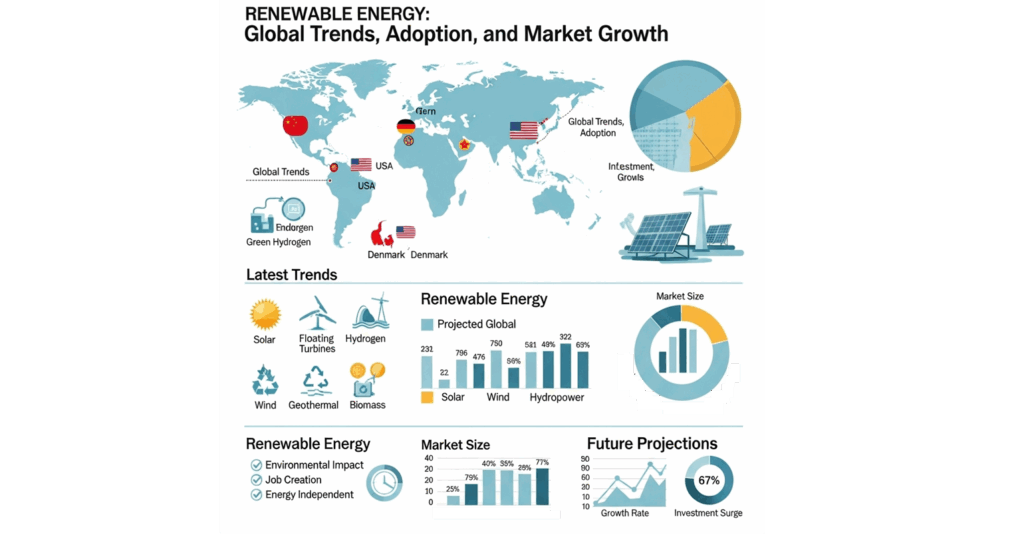
It’s no longer a question of “if” but “when.” Investment in renewable energy is skyrocketing, with figures reaching record levels. In 2025, global investments in solar, wind, and battery storage are set to surpass $300 billion. But this isn’t just about money—it’s about massive shifts in how the world thinks about power.
China is leading the way with its investments in solar farms, while Europe is setting the pace in wind energy. The U.S. isn’t far behind, doubling down on green energy technologies. As companies and governments realize the economic power of renewables, this isn’t just a trend—it’s the foundation of a global energy market.
Investment Stats at a Glance
- $300 billion invested in solar and wind technologies globally in 2025.
- China accounts for over 30% of global solar energy investments.
- By 2025, renewables are expected to represent over 50% of global energy production.
Policy Momentum and Climate Goals
Governments are stepping up like never before. The renewable energy revolution isn’t just happening on the ground; it’s being driven by policy. As countries aim for net-zero emissions, renewable energy is now at the heart of their strategies. Policies are rapidly being rolled out to accelerate the transition, from tax incentives for clean energy projects to regulations phasing out fossil fuels.
Countries like Germany, India, and Canada are not just making promises—they are setting aggressive climate targets that position renewable energy at the forefront of global policy. It’s clear: climate goals are no longer optional, and governments are ensuring that renewables will play a central role in a sustainable future.
Policy Snapshot
- Germany aims to reduce carbon emissions by 55% by 2030.
- India’s 2030 renewable energy target is 500 GW of non-fossil fuel capacity.
- Canada aims for a 100% clean energy grid by 2050.
What’s Driving Renewable Energy Research Forward?
The path to a sustainable future is being paved by groundbreaking research, powered by a sense of urgency and a drive for innovation. In this section, we’ll explore the key forces that are propelling renewable energy research to new heights—combining technological breakthroughs, government action, and private sector investments.
Technological Needs and Environmental Urgency
The pressing environmental challenges demand rapid innovation, and renewable energy technologies are stepping up to the plate. Efficiency improvements, cost reduction, and energy storage solutions are at the heart of this transformation, as the world seeks scalable solutions to climate change.
- Energy storage breakthroughs are enabling a reliable, scalable energy grid.
- Smart grids and AI integration are enhancing the distribution of energy.
- Hydrogen technology holds promise as a game-changer for clean energy storage and transportation.
The urgency to reduce carbon emissions and secure a sustainable future is driving rapid technological advancements, where every discovery holds the key to addressing a pressing, global challenge.
Government Funding and Policy Support
Governments worldwide are now embracing the role of catalysts in renewable energy research. With policy backing and funding at unprecedented levels, nations are advancing large-scale renewable initiatives, providing critical support for research into next-generation clean energy solutions.
- Billions in subsidies are being allocated for green energy research.
- Government-backed incentives are accelerating the development of solar and wind technology innovations.
- Regulatory frameworks are guiding the expansion of renewable infrastructure.
As governments align their climate goals with funding opportunities, they are creating fertile ground for research breakthroughs that will define the future of clean energy.
Private Sector R&D and Startup Ecosystems
The private sector is playing a pivotal role, with startups and established corporations alike investing heavily in research and development (R&D) to address energy challenges. The renewable energy sector is experiencing a surge of innovation, particularly from startups that possess the agility and creativity to address emerging energy challenges.
- Venture capital is increasingly flowing into clean tech startups.
- Private companies are driving breakthroughs in solar, wind, and battery technologies.
- Collaborative efforts with universities and research institutions are accelerating the development of new solutions.
The private sector’s growing commitment to sustainable solutions is fueling collaborative research that advances energy innovation, creating real-world applications that bring us closer to a clean energy economy.
Breakthroughs in Solar Energy Research
The next generation of solar energy is on the horizon, driven by cutting-edge breakthroughs that promise to revolutionize how we capture and use the sun’s power. From perovskite solar cells to agrivoltaic systems, solar energy research is advancing at an unprecedented pace, making it more efficient, sustainable, and accessible. This section explores the latest innovations and technologies that are pushing the boundaries of what solar power can achieve.
High-Efficiency Perovskite Solar Cells
One of the most exciting solar energy breakthroughs is the development of perovskite solar cells. These next-gen solar cells offer a combination of high efficiency and low manufacturing costs, making them a game-changer in the solar market. With the ability to convert more sunlight into electricity, perovskites are rapidly gaining traction as a viable alternative to traditional silicon-based cells.
- Perovskite cells have achieved efficiencies above 25%, with the potential to exceed 30% in the near future.
- Flexible perovskites open up opportunities for solar integration on a wide range of surfaces, from windows to clothing.
- Cost-effective manufacturing methods are lowering production prices, driving scalability.
The promise of high-efficiency perovskite solar cells is propelling solar research into the future, offering clean energy solutions that are both economically and environmentally viable.
Tandem Solar Technology
Imagine stacking solar cells for even better performance. Tandem solar technology is achieving this by combining perovskite with traditional silicon solar cells, thereby boosting overall efficiency. By creating a multi-layer system, each layer captures different wavelengths of sunlight, resulting in higher energy output and greater efficiency compared to single-layer solar technologies.
- Tandem cells have already reached 30% efficiency, with researchers pushing for 35% and beyond.
- This innovative approach uses the strengths of both silicon and perovskite materials.
- The lower cost and versatility of tandem solar cells make them a competitive player in the renewable energy market.
Tandem technology is breaking new ground, offering the potential to revolutionize solar energy, making it even more efficient and accessible to all.
Floating and Agrivoltaic Solar Systems
Floating solar systems and agrivoltaics are revolutionizing the approach to solar panel placement. Floating solar panels, deployed on bodies of water, can harness unused space and utilize natural cooling to enhance efficiency. Meanwhile, agrivoltaic systems are bringing solar panels to farms, where they can be integrated with agricultural activities, providing dual-use solutions for land.
- Floating solar can reduce water evaporation while generating clean energy.
- Agrivoltaic systems are benefiting farmers by enhancing crop yields and generating additional income through solar energy.
- These systems are being implemented on a broad scale, with floating solar installations already powering several countries.
With floating and agrivoltaic solar systems, we’re unlocking new spaces for solar power generation, making solar energy more sustainable, versatile, and integrated into our ecosystems.
Advancements in Wind Power Innovation
The future of wind energy is unfolding before our eyes, driven by technological advancements that are pushing the limits of what wind power can achieve. Wind turbines are evolving to harness more energy, operate more efficiently, and reduce environmental impact. From offshore installations to AI-powered blade designs, innovations in wind power are not just enhancing performance—they are shaping the future of renewable energy.
Larger, Offshore, and Floating Wind Turbines
Offshore wind farms are expanding to capitalize on the stronger, more consistent winds found at sea. With larger turbines capable of generating more power, offshore installations are becoming a key player in the push for renewable energy. At the same time, floating wind turbines are opening new frontiers, enabling turbines to be placed in deeper waters where traditional fixed installations were previously not feasible.
- Offshore wind farms are expected to account for 10% of global wind energy by 2030.
- The largest floating wind turbines can generate over 10 MW of power, compared to the 4 MW typically generated by traditional turbines.
- Floating technology is lowering installation costs and enabling wind farms to be placed further from coastlines.
These innovations are enhancing the scalability and efficiency of wind energy, providing vast, untapped potential for clean power generation.
AI-Optimized Blade Design and Performance
The advent of AI in wind turbine blade design is transforming the efficiency of wind energy generation. By utilizing artificial intelligence to model and simulate various conditions, researchers can design blades that optimize performance while minimizing wear and tear. AI optimization enables adaptive blades that adjust to wind conditions in real-time, enhancing energy capture and extending the lifespan of turbines.
- AI-optimized blades can improve performance by up to 10% under varying wind conditions.
- Machine learning algorithms are enabling real-time adjustments for maximum efficiency.
- Enhanced aerodynamics reduce drag and improve energy capture efficiency.
AI-driven blade design is setting a new standard for wind power, enhancing efficiency and reliability to meet global energy needs.
Adaptive Wind Farms and Noise Reduction Tech
Adaptive wind farms are changing the way we think about energy distribution. By incorporating real-time monitoring and dynamic adjustments, these farms can optimize energy generation by responding to changing weather patterns. Alongside this, noise reduction technologies are addressing one of the most common concerns with wind power—its impact on surrounding environments. With advances in sound-dampening technology, wind turbines are becoming quieter, improving public perception and making them more suitable for residential areas.
- Adaptive wind farms utilize real-time data to enhance efficiency by adjusting the output of their turbines.
- Noise reduction technology can lower turbine sound by up to 50%, improving community acceptance.
- These innovations are enhancing the social and environmental sustainability of wind power.
As adaptive technologies and noise reduction strategies evolve, wind farms are becoming more efficient, environmentally friendly, and socially acceptable, paving the way for broader adoption.
Game-Changing Developments in Energy Storage
The next frontier of energy storage is unfolding with innovations that promise to revolutionize the way we store and distribute renewable energy. As we move towards a future dominated by clean energy, the need for reliable, cost-effective storage solutions has never been greater. This section delves into the cutting-edge technologies driving the evolution of energy storage, from solid-state batteries to long-duration storage systems that can ensure grid stability.
Solid-state and Flow Battery Innovations
Solid-state batteries are emerging as a game-changer in the energy storage sector. With their higher energy density and safety advantages over traditional lithium-ion batteries, solid-state solutions are poised to power everything from electric vehicles to large-scale grid storage. Flow batteries, which utilize liquid electrolytes to store energy, are also gaining traction due to their scalability and durability, making them an ideal choice for long-term storage solutions.
- Solid-state batteries could increase energy density by up to 50-100% compared to lithium-ion batteries.
- Flow batteries offer the ability to scale energy storage for large-scale applications, with lifespans extending beyond 20 years.
- These batteries provide faster charging times and safer, non-flammable solutions for energy storage.
Both technologies are setting the stage for more efficient energy storage systems, offering longer-lasting, safer, and higher-capacity solutions for integrating renewable energy.
Iron-air and Sodium-ion Battery Applications
Iron-air and sodium-ion batteries are gaining attention as promising alternatives to traditional lithium-ion systems. Iron-air batteries leverage iron to store energy, making them significantly cheaper and more abundant than lithium-based solutions. Meanwhile, sodium-ion batteries are emerging as an affordable and sustainable option for large-scale energy storage, with the potential to replace lithium-ion batteries in various applications.
- Iron-air batteries could offer lower-cost, longer-duration storage, making them an ideal choice for grid-level storage.
- Sodium-ion batteries are expected to be more cost-effective and abundant, offering a more affordable solution for everyday applications.
- Both technologies are gaining traction in long-duration energy storage, addressing the need for grid reliability during extended periods of low renewable generation.
These innovations hold significant promise for cost-effective, scalable storage solutions that can help integrate more renewable energy into the grid.
Long-duration Storage for Grid Reliability
One of the significant challenges in renewable energy is maintaining grid reliability during periods when the sun isn’t shining or the wind isn’t blowing. Long-duration energy storage is emerging as a solution to this problem. Unlike traditional systems, these solutions are designed to store energy for extended periods, ensuring that electricity remains available even during periods of low generation.
- Pumped hydro storage and compressed air energy storage are examples of existing long-duration systems.
- New developments, like long-duration solid-state batteries, are capable of providing grid-scale energy storage for up to days or even weeks.
- These technologies are essential for balancing intermittent renewable power sources, such as solar and wind, thereby ensuring a reliable and sustainable grid.
Long-duration storage solutions are crucial to unlocking the full potential of renewable energy, thereby helping to create a resilient and decarbonized energy grid.
Green Hydrogen’s Rise and Integration with Smart Grids & Digital Technologies
As green hydrogen emerges as a leading clean energy solution, its integration with smart grids and digital technologies is accelerating the potential for a more sustainable and efficient energy system. By harnessing the power of AI, IoT, and blockchain, green hydrogen is not only becoming a game-changer for decarbonization but is also transforming the way energy is produced, distributed, and consumed. In this section, we examine how green hydrogen is integrating with cutting-edge technologies to enhance energy forecasting, improve monitoring systems, and facilitate peer-to-peer energy trading.
AI and Machine Learning in Energy Forecasting
Artificial Intelligence (AI) and machine learning are playing a crucial role in optimizing energy forecasting, particularly in integrating green hydrogen into the energy system. By analyzing large datasets from renewable energy sources and hydrogen production processes, these technologies are enhancing prediction accuracy, enabling more informed energy management, and improving grid stability.
- AI is helping to predict hydrogen demand and production patterns, thereby optimizing storage and distribution in real-time.
- Machine learning models are being utilized to forecast fluctuations in renewable energy generation, thereby aiding in improved hydrogen storage and grid balancing.
- By improving the accuracy of energy supply-demand forecasts, AI helps prevent energy shortages and waste, ensuring green hydrogen can be seamlessly integrated into the grid.
Through AI-powered forecasting, energy systems can become more responsive and efficient, allowing green hydrogen to be stored, distributed, and utilized effectively.
IoT-based Energy Monitoring Systems
The Internet of Things (IoT) is transforming the way we monitor and manage energy consumption. By integrating IoT-based monitoring systems with green hydrogen production and smart grids, operators can gain real-time insights into energy usage, hydrogen storage levels, and overall system performance, leading to smarter and more efficient energy distribution.
- IoT sensors are deployed across energy systems to monitor hydrogen storage, flow rates, and system performance.
- These systems enable real-time tracking, allowing for quick adjustments in energy distribution and ensuring optimal utilization of hydrogen.
- Predictive maintenance through IoT helps identify potential system failures early, reducing downtime and maintaining energy reliability.
By embedding IoT technologies into green hydrogen infrastructure, we can unlock more efficient, transparent, and scalable energy systems.
Blockchain for Peer-to-Peer Energy Trading
Blockchain technology is revolutionizing how energy is traded, particularly in peer-to-peer (P2P) energy trading systems. As green hydrogen becomes more integrated into the energy mix, blockchain enables decentralized energy exchanges where consumers and producers can securely and transparently trade green hydrogen and renewable energy credits.
- Blockchain ensures secure and transparent transactions, eliminating intermediaries and reducing transaction costs.
- It enables the creation of energy marketplaces, where green hydrogen producers can directly sell to consumers or other energy producers.
- Blockchain also facilitates the tracking of carbon credits associated with green hydrogen, incentivizing further clean energy production.
Through blockchain-enabled peer-to-peer energy trading, green hydrogen can be traded more efficiently and transparently, accelerating the shift to a more decentralized and digital energy grid.
Sector-Crossing Innovations and Research Synergies
The future of renewable energy is not just about single technologies but about the synergy between different sectors and innovations that work together to create a more sustainable and resilient energy system. Hybrid systems, energy-positive buildings, and advancements in bioenergy are paving the way for cross-sector solutions that will drive global decarbonization.
In this section, we examine how these sector-crossing innovations are converging to create transformative solutions that integrate solar, wind, battery storage, bioenergy, and waste-to-energy technologies.
Hybrid Renewable Systems (Solar+Wind, Solar+Battery)
Hybrid renewable systems are the future of energy generation, combining the strengths of multiple renewable sources to create more reliable, resilient, and scalable energy solutions. By integrating solar with wind or solar with battery storage, these hybrid systems offer enhanced energy output, stability, and flexibility, allowing us to capture energy from diverse sources in varying conditions.
- Solar and wind hybrid systems balance the intermittent nature of both energy sources, ensuring a steady electricity supply regardless of weather patterns.
- Solar and battery systems store excess energy generated during the day, ensuring that energy is available during nighttime or cloudy days.
- Grid stability is improved as these hybrid systems can respond to fluctuating energy demands more effectively
Hybrid systems are reshaping the renewable energy landscape, offering an integrated solution that maximizes renewable energy potential while minimizing energy waste.
Energy-positive Buildings and BIPV (Building-Integrated Photovoltaics)
The concept of energy-positive buildings is gaining momentum, where buildings not only consume energy but generate more than they use. With the integration of BIPV (Building-integrated photovoltaics), buildings are being transformed into self-sustaining energy producers. These innovations are revolutionizing the architecture and construction sectors by combining energy efficiency with solar power generation in innovative ways.
- BIPV systems integrate solar panels directly into the building’s architecture, such as roofs, windows, and facades, allowing structures to harness solar energy efficiently.
- Energy-positive buildings exceed their energy needs, exporting surplus power to the grid or utilizing it for other purposes, thereby creating a net-zero energy ecosystem.
- Innovative building technologies are being integrated to manage energy use, lighting, and heating for maximum efficiency.
Energy-positive buildings and BIPV are not just cutting-edge—they’re the cornerstone of sustainable urban development, blending green architecture with solar energy in a way that makes urban environments more energy-independent.
Bioenergy and Waste-to-Energy Advancements
Bioenergy and waste-to-energy technologies are gaining traction as key solutions for simultaneously tackling waste and producing renewable energy. These technologies enable the conversion of organic waste into proper forms of energy, such as biogas or biofuels, thereby contributing to cleaner energy and reducing landfill waste.
- Waste-to-energy plants utilize biomass and organic waste to produce electricity and heat, enabling cities to manage their waste while generating power.
- Advanced biofuels and biogas are increasingly used in transportation and industry, offering sustainable alternatives to fossil fuels.
- Research into second-generation biofuels, produced from non-food sources such as algae or agricultural residues, is expanding, making bioenergy even more sustainable and scalable.
By advancing bioenergy and waste-to-energy technologies, we are not just tackling energy demands but also creating circular economy solutions, where waste is minimized, and resources are continuously reused.
Challenges That Research Is Trying to Solve
As renewable energy continues to grow, it faces critical challenges that research is diligently working to overcome. From intermittency in energy production to the need for sustainable materials and cost reduction, these issues stand as obstacles to fully realizing the potential of renewable technologies.
In this section, we will explore the key challenges addressed by the latest research, with a focus on how innovation drives solutions for scalability, material dependency, and cost sustainability.
Intermittency and Scalability
One of the most significant hurdles for renewable energy is its intermittency—the challenge of ensuring a stable energy supply when solar and wind generation fluctuate due to weather conditions. Scalability is another critical issue: As the demand for clean energy grows, we need solutions that can scale to meet global needs without compromising efficiency.
- Energy storage technologies, such as batteries and pumped hydro storage, are being developed to store excess energy generated during peak conditions for use during periods of low energy production.
- Hybrid renewable systems, which combine solar, wind, and battery storage, are being optimized to provide more reliable and continuous power.
- Research into smart grids and AI-driven forecasting is making it easier to balance supply and demand, improving grid stability.
Solving intermittency and scalability is key to making renewable energy a viable, long-term solution for global energy needs.
Rare Earth Material Dependency
Many renewable energy technologies, particularly wind turbines and solar panels, rely heavily on rare earth materials, which are not only limited but also pose environmental and geopolitical risks. As demand for renewable technologies increases, the dependency on rare earth materials could become a bottleneck in global supply chains.
- Research is focused on developing alternative materials that reduce reliance on rare earths for solar panels, batteries, and electric motors.
- Recycling rare earth materials from old electronics and renewable systems is another strategy being explored to create a more sustainable supply chain.
- Innovations in material science are leading to new, non-toxic, and abundant materials for energy production that don’t compromise performance.
Addressing the dependency on rare earth materials is vital for ensuring that the growth of renewable energy doesn’t face supply chain disruptions or environmental harm.
Cost Reduction and Lifecycle Sustainability
While renewable energy technologies have made significant progress, their cost remains a key barrier to widespread adoption. From production and installation to maintenance, reducing costs and ensuring lifecycle sustainability are ongoing areas of focus for researchers and innovators.
- Advanced manufacturing techniques, such as 3D printing and modular designs, are helping to lower production costs for solar panels and wind turbines.
- Economies of scale in renewable energy projects are driving down the costs of installation and operation.
- Lifecycle sustainability is a priority, with research focusing on recyclable materials, efficiency optimization, and the development of longer-lasting components to make renewables more cost-effective over time.
By reducing costs and enhancing the sustainability of renewable technologies, the transition to green energy can become economically viable for a broader range of consumers and industries alike.
Conclusion
The breakthroughs outlined here are more than just scientific milestones—they’re the building blocks of a global shift toward cleaner, smarter, and more resilient energy systems. As solar, wind, hydrogen, and storage innovations converge with AI, policy reform, and private investment, renewable energy is no longer a side strategy—it’s the main story.
Yet the road ahead still calls for relentless research, cross-sector collaboration, and solutions that scale. The real win isn’t just in powering homes or grids—it’s in reshaping economies, restoring ecosystems, and giving future generations a fighting chance. The future of energy isn’t just bright—it’s renewable, and it’s already taking shape today.
FAQs
How can businesses leverage renewable energy breakthroughs for cost savings?
What are the challenges with scaling renewable energy globally?
How is renewable energy research addressing global energy storage needs?
What role do private companies play in advancing renewable energy research?
How can we ensure the sustainability of renewable energy materials in the long term?